
Chart Barry County Former Owners
Begin your chart with the latest recorded deed and add a row for every confirmed earlier transfer. Barry County publishes no starting year for its online index. At some point the deed records run out digitally, and the work shifts to deed books, plats, and archive holdings.
| Transfer date | Grantor to grantee | Deed type | Book, page, or instrument |
|---|---|---|---|
| Newest recording | Prior owner to current grantee | As stated in deed | Copy exact reference |
| Earlier recording | Earlier owner to prior grantee | As stated in deed | Match legal description |
| Book-era entry | Indexed parties | Read full instrument | Preserve liber and page |
| Archive-era clue | Name on roll or probate file | Corroborating record | Cite series and year |
A tax roll or newspaper can place a name near land in a certain year. Only a matched conveyance proves the transfer. Hold uncertain clues apart until the parcel description lines up.
Barry Deed Index Access
The Barry County Register search instructions lay out several ways to reach the deed index. A free public workstation at the courthouse handles grantor and grantee searches. Searching there by parcel or legal description runs $1 per minute. Staff will do a search for $5. Copies run $1 per page. Certification adds $5 more. Tapestry charges $8.75 per remote search, and Laredo carries a monthly fee.
The office will pull the latest deed for you, but it stops there. No in-depth title search, and no searching over the phone or email. For repeated backward work, visit the courthouse in person. You can also send a narrow written request. It should name the party, parcel, and instrument you need.
Check the county's current terms on the official Register search instructions page. It also shows any fee changes.
The Register's official page displays the access fees and the limit on latest-deed help.
Reconstruct Barry's Deed Chain
A backward chain turns on party roles, not repeated surnames. The grantor gives up the interest; the grantee receives it. Take the latest grantor, hunt that name as an earlier grantee, and compare the land described in both deeds.
- Identify the current parcel, PIN, legal description, and newest deed.
- Copy that deed's grantor, grantee, recording date, type, and references.
- Search the grantor as a grantee in an older recording. Match lot, block, addition, acreage, township, or section.
- Repeat until the index ends. Ask which deed book, archived volume, microfilm, or workstation index continues the chain.
- Grantor
- The party conveying the stated interest.
- Grantee
- The party receiving it.
- Chain of title
- The ordered sequence of instruments affecting ownership.
- Reverse index
- An index arranged to help search the conveying party.
- Quitclaim and warranty
- Different deed forms whose full terms must be read.
Barry Plats Preserve Owner Clues
The Barry County History Portal plat collection holds scanned 1873 sheets for Hastings wards and many county townships and villages. A historic plat name can bridge a modern parcel number to an old lot description. An old map line, though, proves nothing about today's boundary.
Browse the full collection before relying on any single sheet.
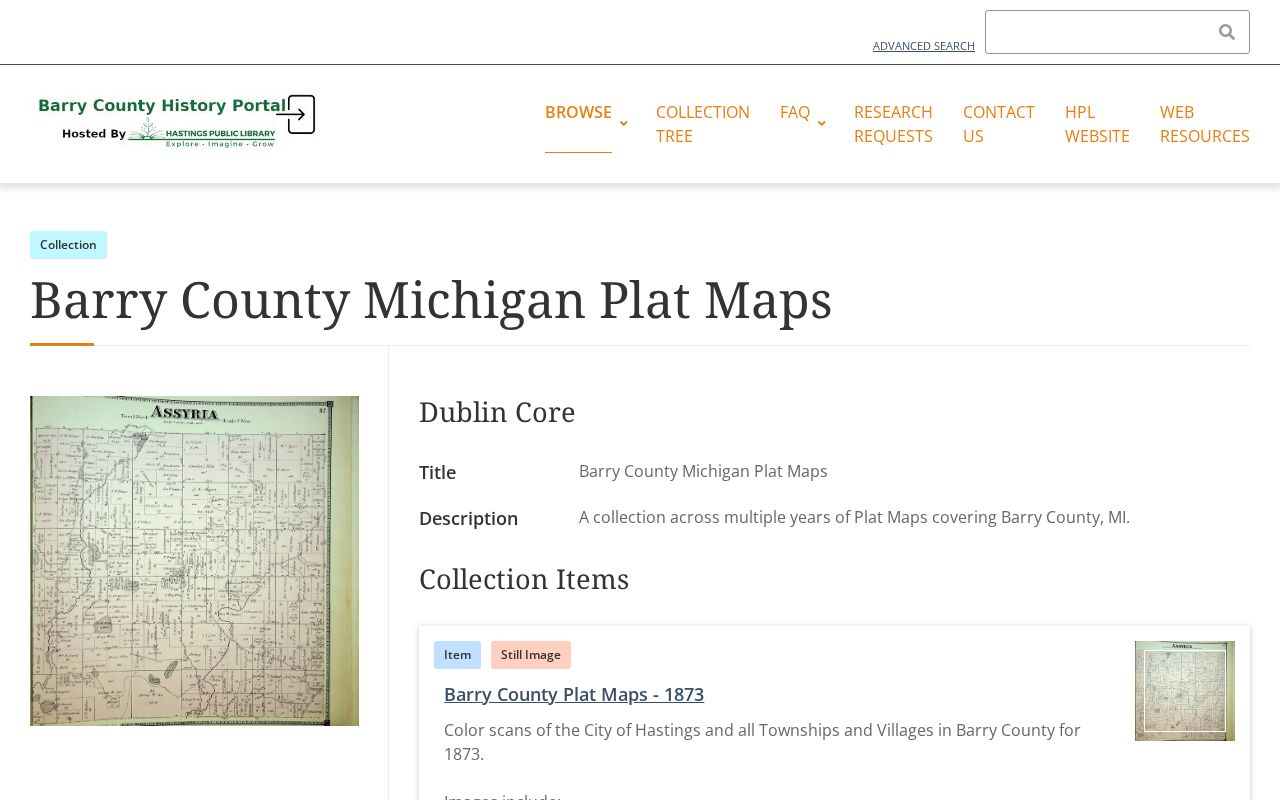
The dated sheets supply search terms and neighboring-owner clues. Cite the year and sheet, then verify each prior owner in the deed records.
Addition Names Unlock Barry Owners
Local legal vocabulary can break a stalled former-owner search wide open. A Hastings planning packet names Supervisor Chase's Addition and Liber 3 of Plats, page 1. Other city records mention the Original Plan of the Village, Jones & Taffee Addition. They also name Riverwalk Condominiums.
Middleville's village plat was recorded in 1859. Its history names Keeler's, Johnson's, Braddock's, and Shupe's Additions from 1869 and 1870. Search the exact addition name together with lot and block data. Never swap it for a modern neighborhood label.
Note: A precise addition and lot separates same-name owners. It works far better than an old street address.
Barry Tax Rolls Bridge Gaps
The Archives of Michigan Barry County guide lists assessment rolls across several ranges. These include 1852 through 1901 plus later groups starting in 1881 and 1930. It also identifies an 1845 through 1849 tax ledger, delinquent receipts from 1850 through 1865, early unpaid-land lists, and later tax rolls.
When you ask the archives, give the record-group number. Add the township, surname, approximate year, and legal description. A roll shows land assessed to a name, but that is only supporting evidence. Keep it apart from the verified grantor-to-grantee sequence in the deed records. The archive route earns its keep when a modern street did not yet exist.
Barry Estate Transfers Need Orders
An owner's death can leave a gap in an otherwise clean deed chain. Barry probate files sit in Archives groups covering parts of the nineteenth and twentieth centuries. Newer public cases may surface through MiCOURT. A death certificate confirms a death, subject to access rules. It does not prove that land passed to any particular heir.
Hunt for the personal representative's authority and the probate order. Then find the deed, the exact legal description, and the recording reference. Newspapers and cemetery files can supply dates or spellings. Still, only a recorded transfer or court order ties the estate to the parcel.
Barry Newspapers Test Owner Clues
Hastings Public Library lists the Hastings Banner from 1856. The library also holds the Nashville News from 1873, plus other local runs. Sale notices, obituaries, and fire reports can help date a former owner's tie to a place. So can construction items and subdivision openings.
Search a surname alongside a street, township, addition, cemetery, or business. Treat the word resident as context, never as ownership. An article should lead back to a deed, probate instrument, plat, or dated roll. Only then should the name join the ownership chain.
How Far Barry Ownership Goes
The county publishes no stated starting year for its online deed index. Tapestry and the internal index may begin at different dates, so ask the office directly. Deed books, archived indexes, and microfilm reach further back than any web tool.
Barry County was set off in 1829 and organized in 1839. Early land was described by township, range, section, acreage, and neighboring owners. It was not described by street address. The Archives places the county in ranges 11W through 16W and townships 1N through 4N. Plat maps, deeds, and tax rolls help translate those old descriptions. The GIS map helps too. For a single recorded copy, see Barry County deed records. Skip the full chain there.
Online depth is unknown. Barry County does not publish an earliest online year. Use prior-owner records lawfully and never to stalk, harass, or harm a person.
Extend Barry Former-Owner Research
The Archives guide lists rural property inventories from about 1939 plus several tax and assessment groups. These fill gaps. They help when the deed chain is clear but a farm, structure, or occupant is not. Requests should name the record-group number, township, section, surname, year, and any addition or lot description. Note which archive holds starred material. Hastings Public Library adds newspapers, photographs, and plat books. The Hastings Banner run starts in 1856. Nashville News follows in 1873. Middleville Sun & News began in 1981. Search a prior owner's name beside a parcel term. Test every clue against a recorded instrument, because a residence notice or obituary never establishes title. Name changes deserve their own log. Track married and former surnames, middle initials, trustee capacity, estate wording, and every "et al." variation, comparing each candidate through the same legal description, acreage, lot and block, or prior-instrument reference. A name-only match is never enough. Early descriptions can cross today's municipal vocabulary. A tract may predate the modern PIN, street, village boundary, or condominium unit. Work forward from the historic description through later plats, tax rolls, and deeds until it reaches the current parcel, never forcing a present identifier onto a record made before that identifier existed.
Keep a separate instrument log as the chain grows. For every deed, record the parties in their stated roles, execution and recording dates, document type, and any consideration shown. Add the book and page or instrument number. Include the full legal description. Add every cited prior record, so the next backward search stays reproducible and shows exactly where an archival clue remains unverified.