
Compare Barry County Value Types
A parcel card often crowds several numbers together. Each has a different legal job. Michigan's framework makes the distinctions matter, so a Barry County property value should never sit beside a deed figure without matching years. Read the label first, then the year, before comparing parcels.
| Value type | What it means | Where it is recorded |
|---|---|---|
| Assessed value | The assessor's value, generally one-half of True Cash Value under Michigan's assessment level | Local assessment roll and parcel record |
| State Equalized Value | The assessed value after equalization, commonly called SEV | Assessment roll and value history |
| Taxable value | The separate capped figure used to calculate property tax | Assessment and tax record |
| Last sale price | Reported consideration or a sale-history amount for a transaction | Deed and available parcel sales history |
True Cash Value is Michigan assessment law's name for a property's usual selling price. One transfer can be evidence of the market. It still does not force the assessor to adopt that exact number. Taxable value can sit below assessed value. A separate constitutional cap governs its growth.
Michigan's Barry Assessment Level
The Michigan Treasury assessment explanation puts assessed value at roughly 50 percent of True Cash Value. It puts SEV at the same level. That ratio is a framework. It does not predict what a parcel will sell for. Nothing obliges a buyer to pay exactly twice the assessed value.
Equalization checks assessment levels across units so the roll meets state requirements. It never turns an SEV into an appraisal. Match like years and like labels. A current SEV and an older sale amount can reflect different dates, physical conditions, and market evidence.
- True Cash Value
- The usual selling price under Michigan assessment law.
- Assessed value
- The local assessment, generally set at half of True Cash Value.
- SEV
- State Equalized Value after equalization.
- Assessment level
- The relationship between assessed value and True Cash Value.
Barry Taxable Value Stays Separate
Taxable value is the number the tax calculation actually uses. It often sits below assessed value or SEV. Michigan caps its annual growth while ownership stays unchanged, subject to the governing rules. That cap explains why two similar Barry County parcels can carry different taxable values.
A transfer of ownership changes the picture. Taxable value generally uncaps the following calendar year and resets to the parcel's SEV. The Michigan change-of-ownership guidance walks through that timing. Never match a sale to a taxable value blindly. Check the roll year and the transfer date.
Note: “Uncapping” resets the taxable-value path after a transfer; it does not prove any future sale price.
Check a Barry Property Value
Two portals carry the lookup work. Barry County BS&A Online offers Address, Name, and Parcel Number searches plus a Detailed Record Search. FetchGIS adds PIN, owner-name, and street-address routes. Whatever the entry point, confirm every visible field against the parcel you open.
- Search the exact street address. If it fails, identify the PIN in FetchGIS and retry by parcel number.
- Confirm the situs, municipality or assessing unit, legal description, and displayed tax year.
- Copy assessed value, SEV, taxable value, and each year label exactly as shown.
- Review available sales history and the newest deed separately. Record the transaction date and stated consideration where present.
- Contact the local city or township assessor when a field, change, or parcel history needs explanation.
The BS&A landing page is the official starting point for Barry County parcel lookups. Open the live Barry BS&A portal for current results.
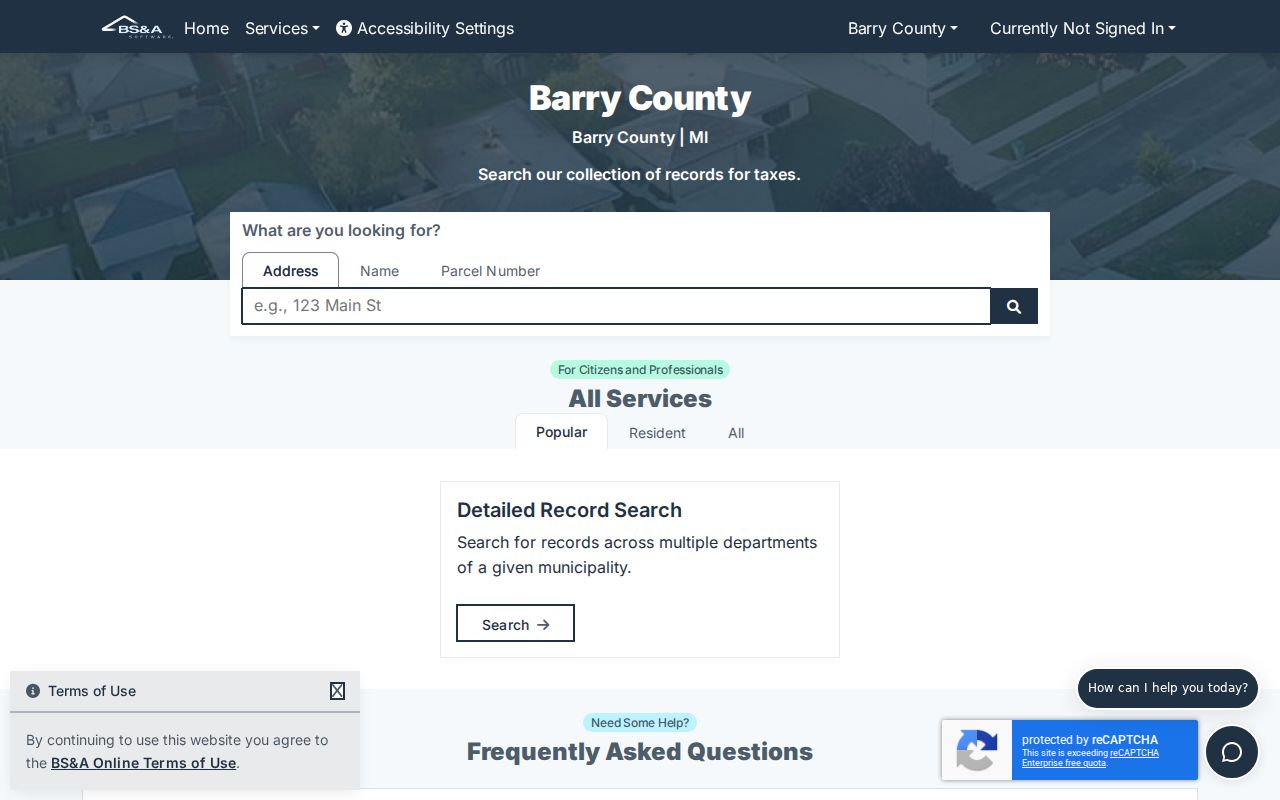
The landing page itself shows no value figures. Once the right parcel opens, save or print the parcel card with its source date.
Barry GIS Shows Value History
FetchGIS lines up prior-year columns labeled MBOR Assessed, Final SEV, and Final Taxable. These cover the last year and the year before. Land value, land improvements, the tax description, and a Sales Information area sit nearby. Those labels help explain how a Barry County property value moved over time.
Some parcels show blanks. Fields may be empty or unavailable. Record blank as blank. Never convert a blank to zero, no sale, or no improvement. When you download a result, save the tax year, PIN, report title, and any visible disclaimer with it.
Print options may include Map, Tax History, and Photo. Report choices can cover water, soil, PID, HPT, and sales material. These are evidence-packet tools, and none guarantees data in every category.
Barry Building Fields Add Context
A value record can carry acreage, frontage, depth, zoning, and land improvements. Building facts may follow. They range from year built and style to living area, rooms, baths, foundations, garages, porches, decks, and agricultural or commercial structures. Those fields expose the model's inputs. They also reveal when two parcels make poor comparisons.
Physical fields still need a date. A permit, addition, demolition, parcel split, or delayed inspection can leave the online description stale. It can trail current conditions. Ask the local assessor about a correction when a building fact is wrong. The record states the roll's data. It never replaces an inspection or settles a building's condition.
Barry Sale Price Is Evidence
A deed's stated consideration tells you what one transaction said. It does not equal market value. It also does not match assessed value, SEV, or taxable value. Before trusting the figure, read the full instrument and its transfer-tax language. Those words often explain what the number really represents.
Check the recording date, any stated sale date, the parties, the legal description, and the parcel identity. Compare them against each other. A family transfer may not behave like an open-market sale. So may an estate event, a land contract, a partial-interest conveyance, or a combined tract. Let the property records support any conclusion; never guess at circumstances they do not show.
When a price drives a real purchase decision, weigh several current sources. Get qualified valuation advice too. The recorded deed still matters, though. It anchors the sale evidence to a documented event in the Barry County property records.
Hastings Dates Barry Assessments
The Hastings City Assessor page offers a dated example of how one Barry assessing unit publishes its value calendar for 2026. Notices were to be mailed by the end of February. The page gives a March 1 contact point for a missing notice and lists the city's March Board of Review dates and protest-letter deadline. It stands as a concrete city illustration of the assessment cycle.
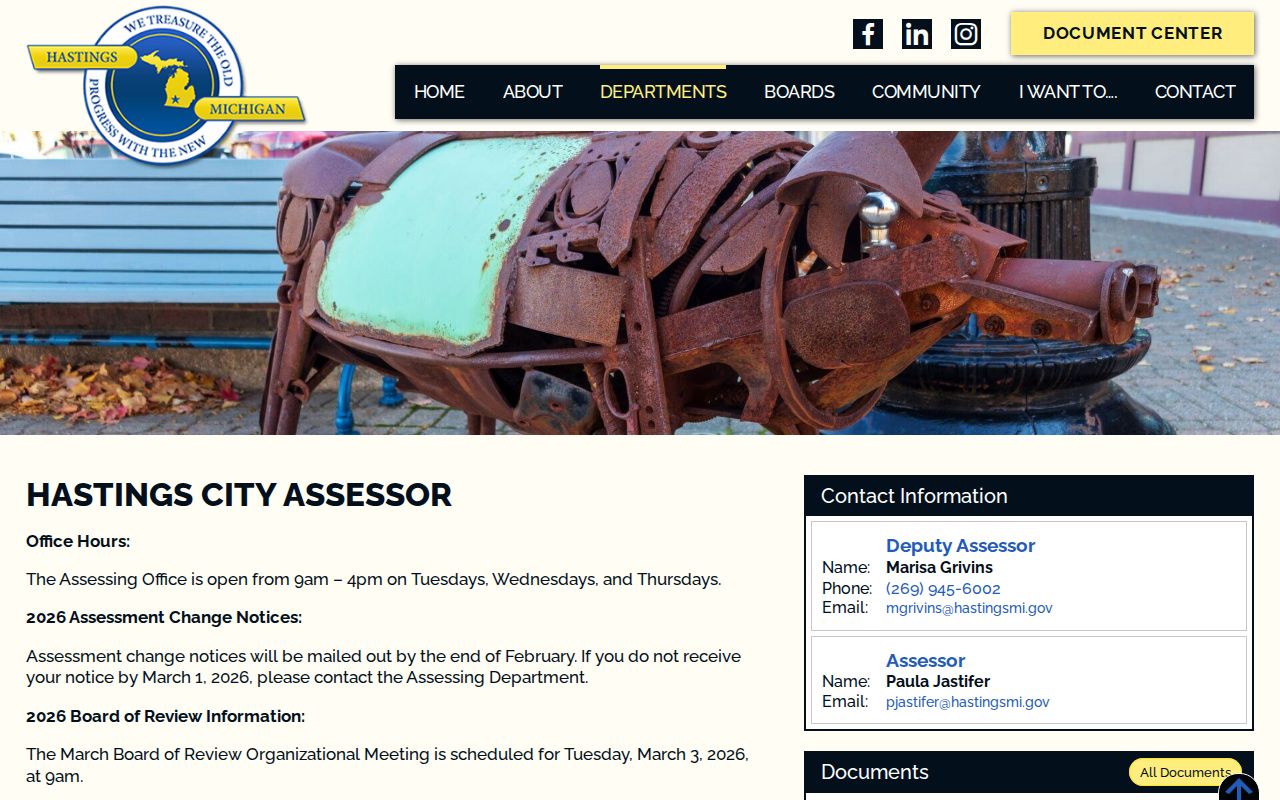
Treat those dates as one city's example. They are not a countywide trend. They also do not set a schedule for every township and village in Barry County. Any property value you pull belongs to a specific assessing unit and a specific notice year. Pair the two before relying on either. Tax bills, exemptions, and appeals get their detail in the Barry County property tax records material.
Middleville Plans Are Value Clues
A 2026 Middleville notice for Kellogg Crossing shows how planning facts attach to a parcel. It identified a PIN, acreage, zoning, a proposed lot count, an outlot, density, a house-size range, bedroom and bath ranges, and a garage concept. That is planning evidence tied to one parcel number. It can give context for later parcel splits or building records.
The notice proves nothing further. It does not show that construction occurred, that a final plat was recorded, that each lot was conveyed, or that the assessor adopted any value. Follow the proposal through later minutes, permits, plats, deed records, and assessor files. No official countywide percentage trend exists in Barry County sources, so do not infer one from this single development.
Limits of Barry Property Values
An assessed value exists for the public assessment system. It is not a promise of what a buyer will pay. It is not what a lender will accept or an appraiser will conclude, either. Sale evidence can be old or atypical. GIS map layers and parcel fields may also trail physical changes on the ground.
Start with the online property search. If the record needs clarification, call the city or township assessor. You can also request the parcel file. County Equalization handles roll review and mapping coordination. Michigan FOIA works for a specific nonexempt public record. But a narrow request should name the PIN, the year, the document type, and the desired fields. Historic values may sit in Archives of Michigan assessment-roll groups rather than a current portal.
Value is not an appraisal. A Barry County assessed value supports taxation and does not state what the property will sell for. Verify the year, source, and value type.